














Common Misconceptions About Business Internet Pricing
March 11, 2026 Category: Business Services
Common Misconceptions About Business Internet Pricing
Why Business Internet Pricing Is Often Misunderstood
Many business Internet pricing misconceptions happen when businesses compare numbers without comparing structure. Speed, monthly rate, and promotional discounts are easy to see, but infrastructure is not.
Business Internet pricing reflects how a connection is built and supported. It reflects network design, upload capacity, escalation structure, and the level of stability required to support daily operations, not just Mbps.
In simple terms, business Internet pricing is shaped by infrastructure and service design, not just speed. When structure is ignored, pricing feels inconsistent. When structure is understood, pricing becomes logical.
Below are five common business Internet pricing misconceptions that regularly create confusion when businesses evaluate Internet costs.
Misconception #1: Price Is Just About Speed
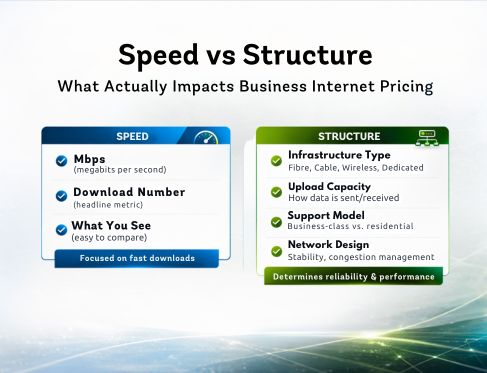
Speed is the easiest metric to compare, but it is also the least complete. If two providers advertise 300 Mbps, it may seem reasonable to expect similar pricing. However, identical speeds can be delivered through very different network structures.
For example, a shared cable connection and a fibre-based connection may advertise the same download speed, but they may not perform the same way under sustained demand.
Business Internet pricing reflects several structural factors:
- The infrastructure serving your address
- Whether the connection is shared or dedicated
- Upload capacity and sustained performance
- How traffic is managed during peak hours
- The support and escalation model attached to the service
As a connection becomes more critical to business operations, raw speed comparisons become less useful. Speed indicates how fast data can move, but it does not explain how the connection behaves when multiple systems are running at once or how quickly issues are resolved.
Before comparing price alone, ask:
- What network is this built on?
- How does it perform under load?
- What happens when something goes wrong?
If you want a deeper look at how capacity differs from headline speed, see our guide on How to Choose the Right Internet Speed for Your Business.
Misconception #2: Business Internet Is Just Residential at a Higher Price
This assumption often comes from comparing monthly rates without comparing expectations. Residential service is designed for household activity, while business service is designed for operational continuity.
A household can usually tolerate short interruptions or occasional slowdowns. A business running cloud accounting software, VoIP systems, or point-of-sale terminals often cannot.
Business Internet typically includes:
- Defined business support channels
- Clear escalation paths
- Stability expectations for multiple concurrent users
- Optional static IP configurations
- Service structures built around uptime
The pricing difference reflects that design. Business connectivity is not simply faster home Internet. It is built around different performance and support standards.
When comparing costs, the relevant question is not “Why is this more?” but “What level of stability and support does this business require?”
Misconception #3: All Providers Price the Same Way
They do not. Business Internet pricing is heavily influenced by infrastructure, and infrastructure varies by address.
Two businesses operating in the same Ontario city can have very different connectivity options depending on:
- Fibre availability at their specific location
- Distance from network buildouts
- Shared versus dedicated infrastructure
- Local network capacity
This is why availability varies by address. If you have not reviewed it, our article on Why Service Availability Varies by Address explains how qualification works and why pricing can differ.
Pricing differences between providers often reflect structural differences in how the network is built, maintained, and supported, not simply pricing strategy. Without understanding what infrastructure serves a specific address, price comparisons lack context.
Misconception #4: Switching Providers Automatically Lowers Costs
Promotional pricing creates that impression. Sometimes switching reduces monthly cost. Sometimes it shifts cost elsewhere.
Changing providers can involve:
- Installation and activation
- Equipment changes
- Service requalification
- Contract alignment
- Temporary operational disruption
The cheapest connection is often the one that costs the most when something fails. Evaluating price properly means looking beyond the first invoice. It means considering long-term stability, responsiveness, and operational impact.
Our overview of How Business Internet Pricing Actually Works breaks down how infrastructure and service structure influence long-term cost.
Misconception #5: Advertised Speed Tells the Whole Story
Download speed is easy to market, but business performance depends on more than peak download numbers.
Upload capacity, latency, device count, and concurrent usage patterns all affect daily reliability. A five-person accounting firm using cloud-based tax software places very different demands on a connection than a retail shop running a single POS terminal, even if both purchase the same speed.
When performance feels inconsistent, the issue is not always insufficient speed. It may be upload constraints, network congestion, or structural capacity limits.
Evaluating price without considering how the connection is used often leads to overpaying for unnecessary speed or underinvesting in necessary stability.
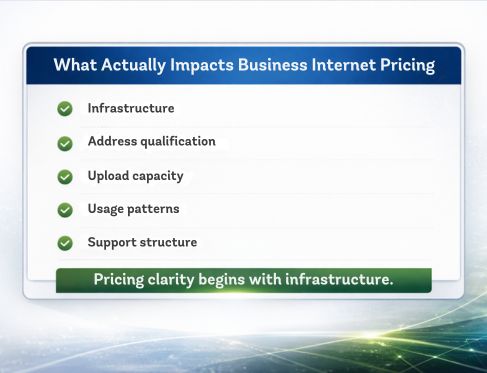
What Actually Matters When Evaluating Business Internet Pricing
Business Internet pricing becomes clearer when viewed through structure rather than surface metrics.
Before focusing solely on monthly rate, consider:
- What infrastructure serves this address?
- How critical is this connection to daily operations?
- How many systems depend on it simultaneously?
- What support response time is acceptable?
- How will usage evolve over the next 12 to 24 months?
Pricing clarity begins when infrastructure is understood, not when speeds are compared.
Frequently Asked Questions About Business Internet Pricing
What affects business Internet pricing?
Infrastructure type, address qualification, upload capacity, service structure, and support expectations all influence pricing.
Is business Internet more expensive than residential?
In most cases, yes. Business service includes different stability, support, and escalation standards designed for operational use.
Why does pricing vary by address?
Infrastructure availability differs by location. Fibre access, network design, and local capacity all affect qualification and pricing.
Does higher speed always mean better performance?
No. Performance depends on how the connection is built, supported, and used, not just peak download speed.