















What Businesses Actually Mean When They Talk About Reliable Internet
June 11, 2026 Category: Business Services
What Businesses Actually Mean When They Talk About Reliable Internet
Most businesses do not question Internet reliability until something begins slowing the workday down. A payment terminal hesitates during a customer rush. Video meetings become unstable in the middle of the afternoon. Cloud applications stop responding as quickly as they normally do. Employees begin adjusting how they work around delays that were not there before.
In many cases, the connection itself is still technically online. That is what makes reliability difficult to define in a business environment. Reliability is rarely just about whether the Internet works or does not work. It is about whether systems continue performing consistently as demands across the business increase throughout the day.
For businesses, reliable Internet is less about peak speed and more about operational consistency.
Why Reliability Is Different From Uptime
Businesses often think about reliability in terms of outages. If the Internet is available, the assumption is that everything is operating normally. In practice, most connectivity issues do not begin with a full outage. They begin with inconsistency.
Systems take longer to respond during busy periods. Cloud platforms become less predictable under heavier demand. Employees retry tasks, delay uploads, or quietly adapt workflows to avoid frustration.
None of these issues may seem significant on their own. Together, they begin affecting productivity, communication, customer experience, and the overall pace of the workday.
That is why reliability is not simply about uptime. It is about maintaining consistent performance while the business is actively operating.
Why Speed Tests Do Not Reflect the Full Business Experience
Advertised speed is often the first thing businesses compare when evaluating Internet service. However, speed tests only measure part of the experience. A connection may appear fast during a quiet moment while struggling once multiple employees, cloud applications, customer transactions, file uploads, video meetings, and connected devices are all active together.
This is where many businesses begin realizing that speed alone does not automatically translate into reliability. Reliable Business Internet is not simply about reaching high speeds under ideal conditions. It is about maintaining stable performance under real operational demand.
Why Modern Business Activity Places More Pressure on Networks
The way businesses use connectivity has changed significantly over time. Many daily operations now depend on cloud-based software, real-time collaboration tools, remote access platforms, connected devices, video communication, payment processing systems, and shared online environments operating simultaneously.
At the same time, businesses are constantly sending data, not just receiving it. Video meetings, cloud backups, shared files, remote collaboration, and customer-facing systems all place demand on upload capacity throughout the day. As more activity overlaps, networks must support increasing levels of concurrent demand across the business.
This is often where reliability issues begin becoming more noticeable, particularly during periods of heavier activity when multiple systems and users are competing for bandwidth at the same time. Understanding what causes Internet slowdowns during busy periods can help businesses recognize these patterns earlier.
What Reliable Internet Actually Feels Like
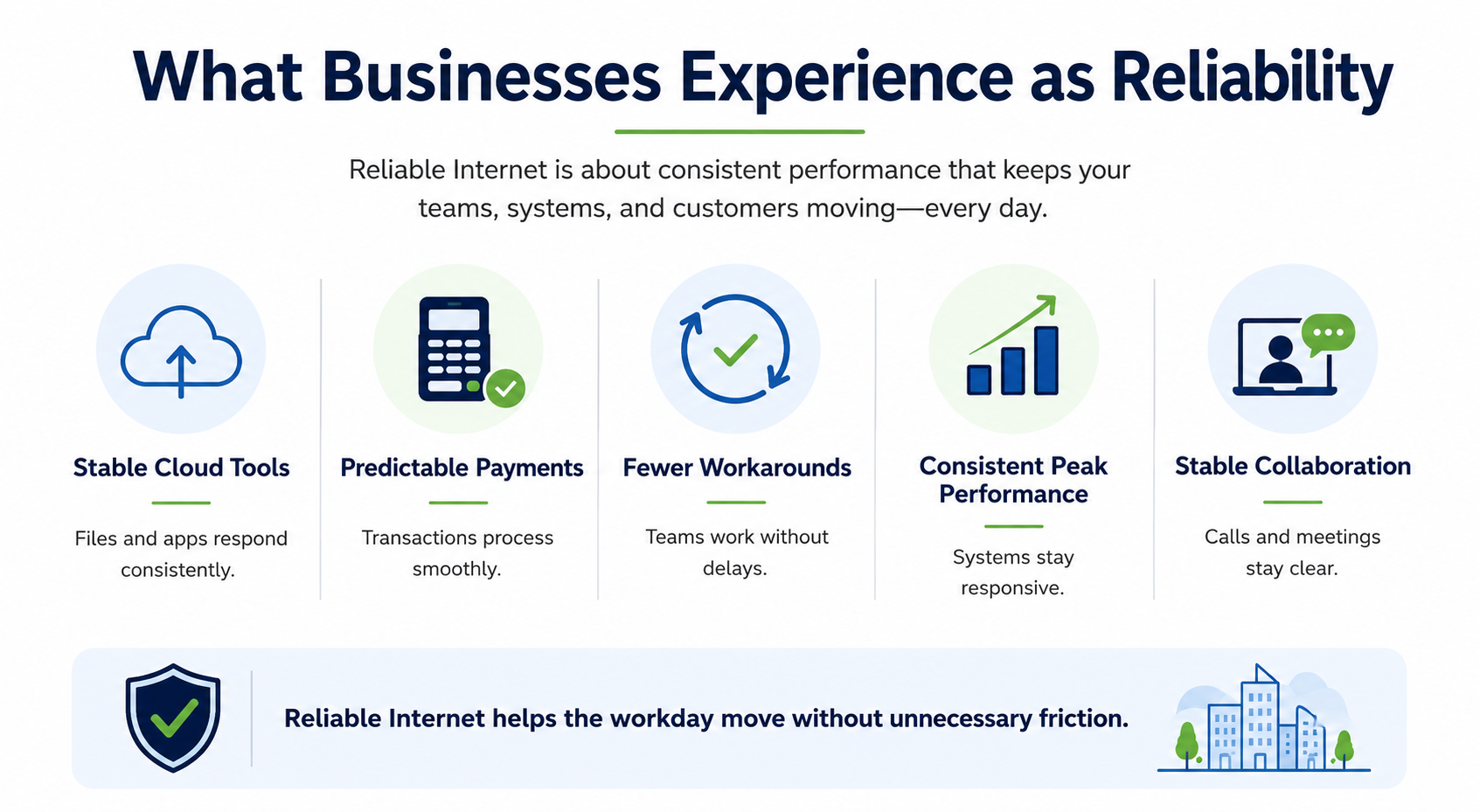
Reliable Business Internet often becomes most noticeable when employees rarely think about it at all. Systems respond consistently. Video meetings remain stable. Cloud applications behave predictably. Customer transactions process without hesitation. Teams continue working without adjusting routines around connectivity limitations.
The connection simply supports the pace of the business the way employees expect it to. That consistency matters because businesses rely on operational flow. Once systems become unpredictable, even small delays can begin creating friction across the workday.
Here’s what reliability looks like in day-to-day business operations.
Reliability Supports Operational Confidence
Reliable connectivity is not static. As businesses evolve, more employees, cloud platforms, connected devices, customer-facing systems, and real-time communication tools can increase pressure on the network over time.
Over time, a setup that once felt sufficient may begin struggling as the business adds more people, tools, and connected systems. That is why planning Internet capacity is worth revisiting as operations evolve.
That is why businesses benefit from periodically reviewing:
- how the network is being used
- when demand is highest
- which systems are most critical
- whether the current setup still supports the pace of daily operations or whether it may be time to upgrade Business Internet to better support current demand.
Reliable Business Internet is not defined by the highest speed on paper. It is defined by how consistently the connection supports employees, systems, customers, and the pace of the business throughout the day.
As more operations depend on cloud platforms, connected devices, and real-time communication, reliability becomes increasingly tied to operational confidence. The goal is not simply staying connected. It is making sure the business can continue operating without unnecessary friction as demands evolve.
If your business is reviewing connectivity performance, explore Execulink Business Internet solutions to find options designed to support reliable day-to-day operations.